 VapeWholesaleHub
21700 Battery When to Add a Second Factory — Convenience Retail
Retailers rarely lose money on 21700 battery because of price. They lose money because the first container was bought on a photograph. This page walks through what actually matters when you source 21700 battery at scale, written from the buying desk rather than the marketing department.
Freight, Customs and Timing
Model 21700 battery freight both ways before choosing a method: cost per unit and cost per week of delay. The second figure is the one that decides whether a cheap option was actually cheap.
Ask your forwarder for the 21700 battery transit history on your lane, not the advertised schedule. The gap between the two is the buffer you should build into your reorder point.
What 21700 Battery Really Costs Landed
Hold a small 21700 battery buffer in your pricing model for currency movement. A few percent on a container is a real number, and it is easier to plan for than to absorb.
Hold a small 21700 battery buffer in your pricing model for currency movement. A few percent on a container is a real number, and it is easier to plan for than to absorb.
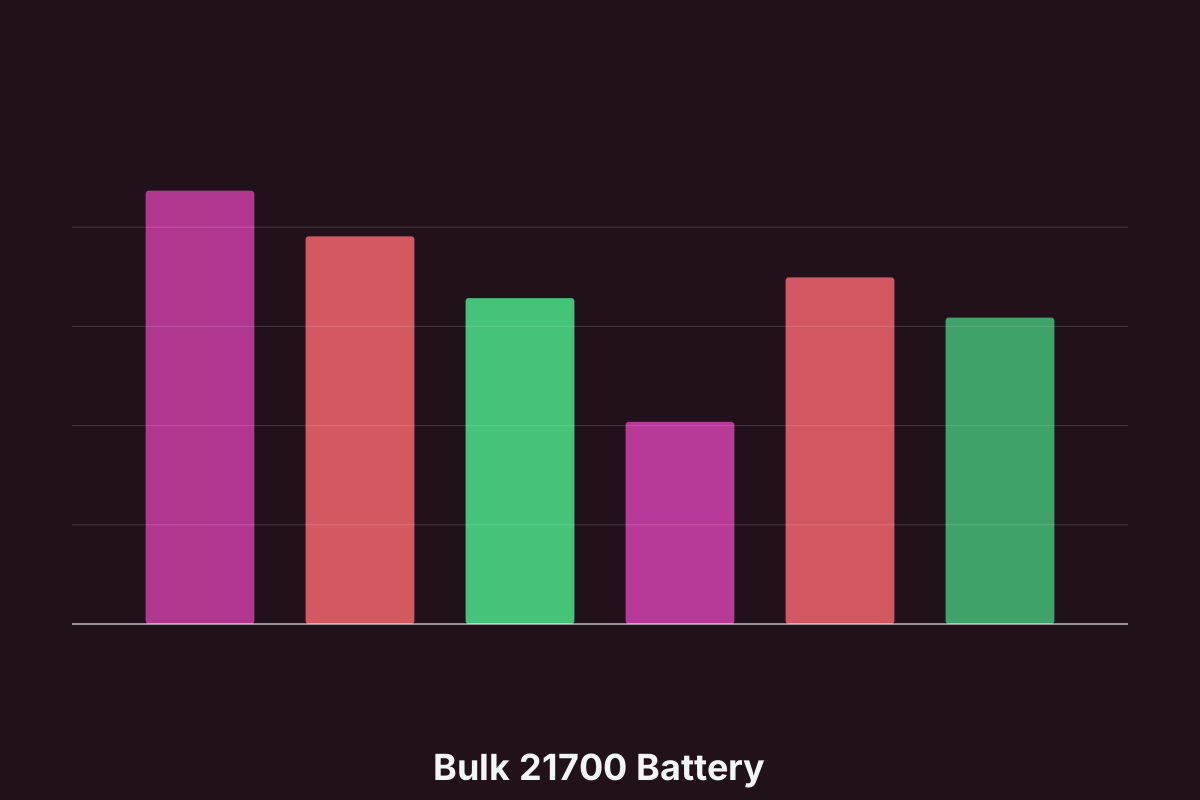
Indicative reference points for planning purposes: entry tier from USD 1.97 per unit at 1000 units, mid tier at USD 1.56, and volume tier at USD 0.68 for full container quantities. These figures move with specification, packaging and freight, so treat them as a shape rather than a quote.
Where Demand Is Heading
One shift worth planning for: shorter 21700 battery reorder cycles with smaller average drops. It favours suppliers with flexible production slots over those who only want large annual commitments.
How 21700 Battery Batches Are Checked
The cheapest quality control step is a retained sample. Keeping three sealed units from every 21700 battery batch costs almost nothing and turns any dispute into a simple comparison instead of an argument over photographs.
- Keep sealed retained samples from every production batch.
- Confirm the current customs classification with your own broker.
- Rotate stock by batch code rather than by delivery date.
- Ask how the factory measures puff count, then compare like with like.
- Agree the tolerance band in writing before approving artwork.
What to Fix Before Approving 21700 Battery
Specification sheets are where a 21700 battery deal is won or quietly lost. Two samples can look and taste the same while using different coil wire, different wicking density and different tolerances on the mouthpiece. Those details decide how the unit behaves in week three rather than minute three.
Ask any factory for the same 21700 battery sample twice, three months apart. If the second sample drifts, the production line is running without statistical control and your reviews will drift with it. Consistency over time is a more useful signal than a single good sample.
| Product category | Closed pod |
|---|---|
| Resistance band | 0.6 - 0.8 ohm |
| Capacity tolerance | +/- 3% |
| Puff count method | Machine cycle 2s on / 18s off |
| Master carton | 300 units |
| Carton weight | 11.8 kg |
| Shelf life | 18 months |
| Storage | 15-25 C, dry, away from direct light |
Turning 21700 Battery Into Repeats
A 21700 battery display that answers strength and flavour without staff involvement outsells a prettier one that does not. Most customers will not ask, so the fixture has to do the work.
Practical Checklist
- Agree the tolerance band in writing before approving artwork.
- Start with a mixed carton and let your own sell-through decide.
- Write the complaint threshold into the order terms.
- Confirm the current customs classification with your own broker.
- Check carton dimensions against your freight quote before confirming.
- Keep sealed retained samples from every production batch.
Frequently Asked Questions
What if a batch does not match the sample?
Keep the retained samples from the approval stage. If a delivered batch measurably differs, we compare against the retained set and resolve it against the production record. This is why we insist on sealed retained units from every run.
Is there support for in-store material?
Yes. Shelf talkers, counter cards and simple planogram suggestions are available for 21700 battery ranges that reach a sensible volume. Most retailers find the plain strength and flavour cards do the most work.
How are price changes handled on repeat orders?
{K} pricing is reviewed against input costs and volume rather than adjusted casually. Any change is confirmed in writing before the next order is scheduled, with the reason stated so you can judge it yourself.
What happens if my market changes its rules?
Regulations move, and packaging or documentation sometimes has to follow. We keep approved artwork files on hand so that a required change is a reprint rather than a redesign, which keeps the cost and delay down.
Can I visit the production facility?
Yes, and we encourage it for larger programmes. Visits are most useful when you already have a draft specification, because you can then check the specific processes behind the numbers you care about.
Next Step
If you take one thing from this page, take the retained sample habit. It costs a few units per batch and it is the difference between a disagreement and a decision.
Related Reading
- Merchandising 21700 Battery Inside a Physical Store — Tight Margin Categories
- 21700 Battery Damage Claims and How to Avoid Them — Cash-and-Carry Formats
- 21700 Battery Handling, Labeling and Regulatory Paperwork — Convenience Retail
- 21700 Battery Flavour Development: From Brief to Production — Specialist Vape Shops
- 21700 Battery Case Study: From First Pallet to Repeat Container — a Printable Checklist
- 21700 Battery Sampling Programme: How to Evaluate Before You Commit — Duty and Tax Worked Out